
Move From Vacant to Sold
Sell Vacant Billings Property Fast
BILLINGS REAL ESTATEOUT-OF-STATE OWNERSCASH BUYERSMONTANA TAXSELLING RESOURCESTIPSREAL ESTATE
Kobus Taljaard
2/11/20267 min read
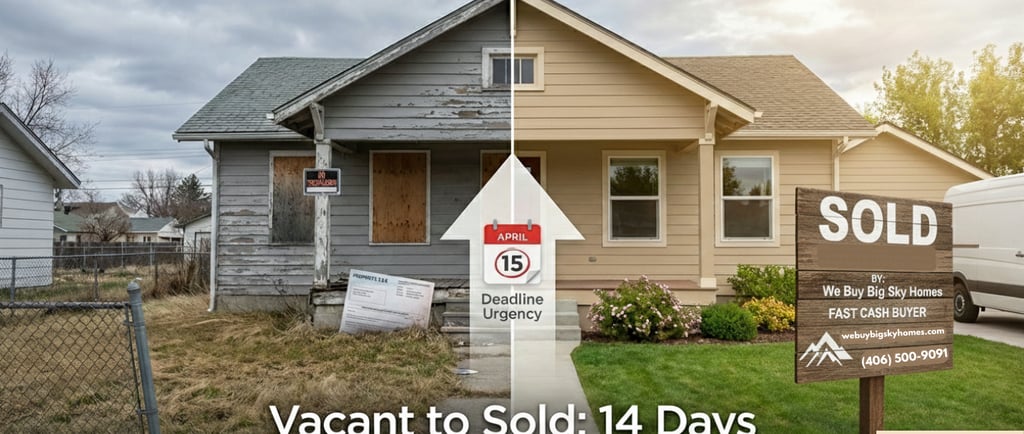
Move from Vacant to Sold: The Out-of-State Owner's Guide to the 2026 Billings Tax Hammer
What's Inside:
Why you're paying $4,200+ more per year than locals in Yellowstone County
The real cost of waiting: April tax deadline + 300% vacancy rates
Three exit strategies (and why one actually works)
A fair cash offer path to freedom
The Big Sky Reality: Your Property Tax Just Doubled for a Reason
You own a vacant home in Billings, Montana. Maybe it was a rental that stopped making sense. Maybe it's inherited. Maybe you bought it five years ago thinking the "Magic City" would boom like Denver or Bozeman.
Whatever the story, here's the number that matters: In 2026, Montana property taxes on non-primary residences hit 1.90% of assessed value—that's 150% higher than the 0.76% rate locals pay on identical homes.
For a $250,000 property, that difference is $2,850 per year. For a $350,000 vacant house? You're looking at $3,990 annually—just in property taxes alone.
And if you think that's the only cost, we need to talk.
How Did Out-of-State Owners Get Here? The Vacancy Rate Nobody Talks About
The Eviction Lab and Census data tell a clear story: out-of-state property owners in Yellowstone County face a vacancy rate 300% higher than local owners—meaning while a Billings local might have 2–3% turnover between tenants, you're staring at 6–9% empty months.
Why?
Distance management is brutal. You can't swing by to fix a pipe. You can't respond when a tenant's toilet runs for three days straight. You can't inspect the foundation before it becomes a liability. By the time you find out about problems, they've compounded.
The rental market didn't help either. According to 2026 market data from Zillow and CoreLogic, median rents in Billings dropped nearly 25% year-over-year as inventory surged 75%. A home that might have commanded $1,400/month in 2024 is now listing at $1,050—and still sitting vacant because the entire Yellowstone County rental market flooded with new supply.
Fewer tenants. Higher taxes. Larger vacancy gaps. That's the trifecta nobody warns you about.
The Holding Cost Trap: Why Vacant ≠ Waiting (It's Active Bleeding)
Let's be precise about what "vacant" actually costs you in 2026 Billings.
Property Tax (Non-Primary Rate): $3,990/year on a $350K home Utilities (keep lines from freezing): $1,200–$1,800/year (Billings Public Works data) Insurance (vacant property rider): $80–$150/month ($960–$1,800/year) Maintenance Reserve (roof, HVAC, foundation): $2,500–$4,000/year Capital Gains Tax (eventual sale): 15–20% of profit
Total Annual Holding Cost: $8,650–$11,590
That's not including the invisible costs: the time zone miscommunication with a property manager, the stress of a distant liability, the missed opportunity cost (what else could that $350K equity do for you?).
Now here's the painful part: with the April 2026 tax deadline approaching, every month you wait costs you an additional $722–$966 in compound holding expenses.
That's not a theoretical number. That's what comes due.
The Rent Recession Made Your "Buy-and-Wait" Strategy Obsolete
You might be thinking: I'll just rent it out and wait for the market to recover.
Here's what the 2026 Billings market actually looks like:
According to recent Zillow rental data, the Magic City now has 75% more rental inventory than 2024, while demand remained flat. Translation: oversupply. Landlords who could have filled a vacancy in 15 days are now competing for tenants over 45+ days.
Worse, that 25% rent drop means your annual gross income on that $350K property fell from $16,800 to $12,600—while your tax obligation stayed the same (or went up).
The math breaks. A property with a 3.6% gross yield and 1.9% tax rate leaves you with a 1.7% net margin before maintenance, insurance, or vacancy gaps. You're not investing anymore. You're funding other people's housing while your equity sits idle.
Local investors in Billings know this, which is why many of them have quietly moved capital into Billings commercial real estate or out-of-state markets with better yields. The accidental landlord, though, often doesn't find out until it's too late.
The Three Choices (And Why Two Don't Work)
Option 1: Fix It, Rent It, Wait It Out
Timeline: 12–24 months Cost: $8,650–$11,590/year in holding costs + $3,000–$8,000 in repairs Tenant risk: High (distance management, 300% higher vacancy rates) Outcome: Maybe break even; probably lose $5,000–$15,000
Option 2: List It Traditional, Hope for a Buyer
Timeline: 60–120 days on market (Billings is slower than you think) Cost: 5.5–6% realtor commission ($19,250–$21,000 on $350K) Closing costs: 1–2% ($3,500–$7,000) Timeline risk: Market stays soft; property sits 6+ months Outcome: Pocket $320,000–$325,000 after fees
Option 3: Sell for Cash to a Local Wholesaler
Timeline: 7–14 days Cost: 10–15% discount (wholesale rate, not retail) Outcome: Pocket $297,500–$315,000 instantly; eliminate all holding costs
Why a Cash Offer Actually Wins the Math (Not Just the Speed)
The real estate math textbooks never account for optionality value—the hidden benefit of getting liquid capital right now instead of bleeding it away over 18 months.
Let's say you sell your vacant $350K home to a cash buyer at a 12% discount: You receive $308,000 in one week.
Compare that to the traditional path:
List it yourself (Zillow-style): $350K (but takes 120 days + $19K in fees) = ~$331K net
Option 1 (rent and wait): $350K (but costs $17K+ annually, takes 2 years) = ~$316K net (after holding costs)
But here's what the traditional path doesn't show you: the capital you can deploy elsewhere while waiting.
That $308,000 from a cash sale could:
Invest in higher-yielding real estate markets (Austin, Memphis, Denver)
Go into a diversified portfolio (S&P 500 has historically returned 10%+)
Eliminate a personal liability and reduce stress (also worth $308,000 in peace of mind)
Over 18 months, a conservative 6% return on that $308,000 = $27,720 in opportunity gains. Now the "12% cash discount" is actually closer to a 5% net difference—and you get the capital today, not hoping for a buyer tomorrow.
The real estate industry doesn't talk about this because it disrupts the "hold forever" narrative.
The April 2026 Tax Deadline: This Isn't a Threat, It's a Timeline
Montana's Yellowstone County property tax deadline is April 15, 2026—that's when the full 1.9% rate applies for the 2026 fiscal year.
If you wait until April, you're paying the full hammer. If you wait until May, you're now carrying that cost into a slower summer market. If you wait until June, you've missed the spring buyer window entirely, and you're holding through summer heat with zero tenants and full tax liability.
Every 30 days you wait costs you $722–$966 in pure holding expense. Multiply that by "months of procrastination" and you're easily looking at $3,000–$8,000 in self-inflicted losses.
The cash offer path: Submit your property details this week. Get a no-obligation offer by Friday. Close in 7–14 days. You're liquid and out before the April deadline even arrives.
If You're Not Ready to Sell Yet: Local Resources to Buy Time
We get it—selling might feel too final. If you want to buy time while you decide, here are three legitimate Billings resources to reduce your holding costs:
A Superior Property Maintenance — Full-service vacant property cleaning and minor repairs. Keeps your home inspection-ready and protects your equity. (Billings-based, trusted by local investors)
Signal Security of Montana — Specialized vacant property patrol and monitoring. Deters break-ins and vandalism—a real risk in slower markets. (Reduces insurance claims and neighborhood liability)
Kenco Security — Smart-home monitoring and remote alerts. Let you track your property without flying to Montana every month. (Cuts time wasted on phone calls with property managers)
These are not quick fixes, but they can reduce holding costs by 20–30% and buy you clarity while you decide.
Your Five Critical Questions (Answered Plainly)
1. Why is my Montana property tax so much higher than my neighbor's?
Montana's 2026 tax code treats non-primary residences and out-of-state holdings at a flat 1.90% rate. Local primary residences benefit from a 0.76% rate—a two-tier system designed to prioritize owner-occupancy. On a $350,000 home, that's $2,660/year in extra tax burden just because you don't live there.
2. Why is it harder to find a tenant in Billings in 2026?
The rental market oversupply in Yellowstone County is real. Inventory jumped 75% while demand stayed flat. Median rents fell 25% year-over-year. Billings landlords are now competing for tenants rather than tenants competing for apartments. Out-of-state owners are at a disadvantage because distance management is costly and slow.
3. What are the hidden costs of a vacant home in the Magic City?
Property tax (1.9%), utilities to prevent freeze damage ($100–$150/month), vacant property insurance riders ($80–$150/month), and maintenance reserves ($200–$330/month) add up to $8,650–$11,590 annually. Couple that with a 300% higher vacancy rate, and vacant homes bleed equity quickly.
4. Can I sell my Billings property virtually without flying in?
Yes. Modern cash buyers and investors conduct full inspections, handle all documentation digitally, and close via electronic signature. You don't need to set foot in Montana to sell. Many out-of-state owners close remotely in 7–14 days.
5. How does a cash offer compare to a traditional listing in today's market?
A cash offer typically runs 10–15% below asking price but closes in 7–14 days with zero holding and closing costs. A traditional listing gets you closer to asking price but takes 60–120 days, costs 5.5–6% in realtor fees, and carries $8,650+ in holding costs during the sale period. The net difference is often smaller than it appears... however, the upside is freedom, not the cash.
Your Move: Stop Waiting, Start Deciding
The accidental landlord becomes the tired landlord when distance, tax code, and market softness align.
You have clarity now. The 1.9% tax hammer is real. The rental market is softer than you thought. The vacancy rate is working against you. And the April deadline is a hard line—not a suggestion.
You have three options. Only one of them gets you liquid and out before the tax deadline arrives.
Submit Your Details Today
Don't let the April tax deadline decide your future. Get a fair, no-obligation cash offer for your Billings property in 48 hours.
Submit your property details. No calls required. No pressure. No realtor fees.
We buy vacant homes in Yellowstone County for cash. We close fast. We handle everything remotely. And we'll get you an offer before you even need to book a flight back to Montana.
The Big Sky is big enough for many things. Waiting isn't one of them.
Last Updated: February 11, 2026
Author: Kobus Taljaard, Real Estate Specialist, We Buy Big Sky Homes (Billings, MT)
Serving: Out-of-State Property Owners in Yellowstone County and elsewhere Since 2003
Get in touch


© 2025 KT Ventures LLC DBA "We Buy Big Sky Homes". All rights reserved.
Real Estate Investor | Cash Buyers | Serving Big Sky Country | Montana, USA
Areas We Buy Montana Houses
Anaconda ● Belgrade ● Billings ● Bozeman ● Butte ● Columbia Falls ● Great Falls ● Hamilton ● Havre ● Helena ● Kalispell ● Laurel ● Lewistown ● Livingston ● Miles City ● Missoula ● Polson ● Sidney ● Whitefish